

How accurate is a progesterone test for dogs?
Sep
If you are trying to determine the best time to mate your dog, progesterone testing can be an extremely useful part of the process. But how accurate is a progesterone test for dogs, and can you rely on the result to tell you exactly when your dog should be mated?
Why is progesterone testing important for dogs?
Progesterone testing is widely used in canine reproduction because progesterone levels change in a predictable pattern around ovulation. By monitoring these changes, your vet or canine reproduction professional can build a much clearer picture of where your dog is in her reproductive cycle.
However, a progesterone result should not usually be viewed as a single number that automatically tells you when to mate. This is because the accuracy of the overall timing depends on the quality of the test, when the blood sample was taken, how the result is interpreted and whether it is considered alongside other information.
So what does a progesterone test measure in dogs?
Progesterone is a hormone produced by the ovaries during the reproductive cycle. As a female dog approaches ovulation, her progesterone concentration begins to rise. Your vet may recommend taking several blood samples over a number of days, as looking at the pattern of progesterone results can be more informative than relying on one isolated measurement.
How accurate is a progesterone test for dogs?
A progesterone test can be very useful for identifying the hormonal changes associated with ovulation, but its accuracy depends on several factors. These include:
- The testing method being used
- The quality and calibration of the testing equipment
- The timing of the blood sample
- How quickly the sample is processed
- Whether the result is interpreted correctly
- Whether previous progesterone results are available for comparison
- Other information about your dog’s reproductive cycle
For this reason, it is more accurate to think of progesterone testing as a timing tool, rather than a test that gives an exact mating date on its own. But when testing is carried out correctly and results are interpreted in the context of the individual dog, progesterone monitoring can provide valuable guidance for planning mating or artificial insemination.
Is a veterinary progesterone test more accurate than a home test?
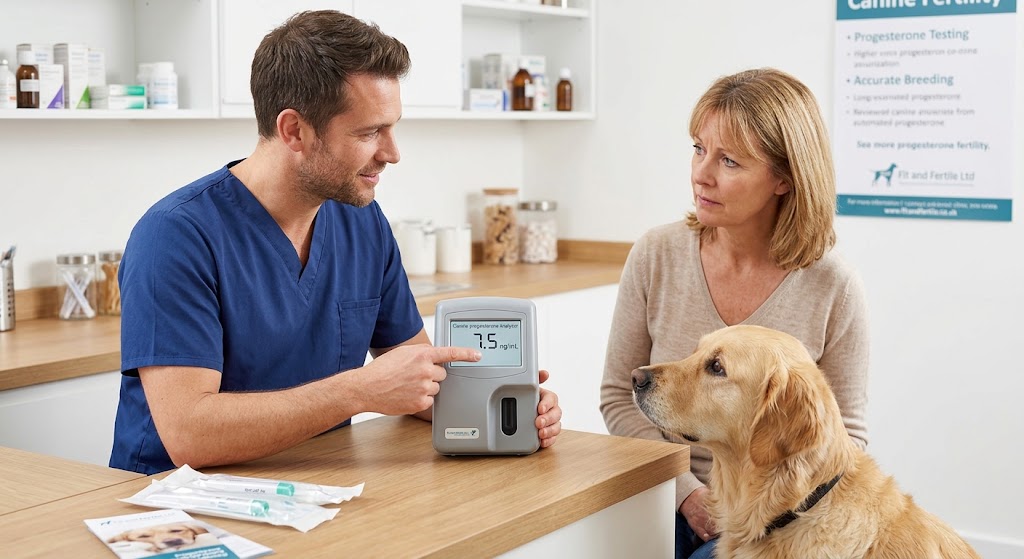
Some veterinary practices and canine reproduction services use laboratory-based testing, while others use analysers designed to provide progesterone results in-house. There are also home testing options available, but these can vary in how results are obtained and interpreted.
If the purpose of testing is to accurately time a mating or artificial insemination, it is important to consider not only whether a test produces a number, but whether that number can be interpreted reliably.
A veterinary professional can also consider the result alongside your dog’s history, physical signs and previous progesterone measurements.
Can progesterone testing improve the chances of successful mating?
Accurate timing is an important part of successful canine reproduction. This is because if mating takes place too early or too late, the timing may not coincide with the period when mature eggs are available for fertilisation. As such, progesterone testing can be very beneficial as this helps to reduce the guesswork by providing information about hormonal changes around ovulation.
However, it cannot guarantee pregnancy, as even when mating is carefully timed, pregnancy can be affected by many other factors, including:
- The fertility of the female
- The fertility and semen quality of the male
- The age and health of both dogs
- The quality of the eggs and sperm
- Reproductive infections or underlying health problems
- The type of semen being used
- The technique used for artificial insemination
This means that progesterone testing is one part of a wider reproductive plan rather than a guarantee of conception.
How does progesterone testing help with artificial insemination?
Progesterone testing becomes particularly valuable when artificial insemination is being considered, as the type of semen being used can influence the timing required.
Fresh semen generally provides more flexibility because sperm can remain viable for a period of time after insemination. Chilled and frozen semen can require more precise timing, particularly because sperm survival may differ depending on how the semen has been processed and stored.
When frozen semen is being used, accurately identifying the appropriate stage of the reproductive cycle can therefore be particularly important.
What if the progesterone result seems unexpected?
Occasionally, a progesterone result may not fit neatly with what you expected based on your dog’s physical signs or the date you believe her season started. There are several possible reasons for this.
The cycle may have started earlier or later than you realised, your dog’s hormonal pattern may not follow the assumptions being made, or there may be differences between testing methods.
This is why an unexpected result should be discussed with your vet rather than used to make a breeding decision in isolation. If necessary, your vet may recommend another blood test or use additional reproductive assessments to clarify what is happening.
What should you do if you are planning to mate your dog?
If you are planning a mating, speak to your vet or a qualified canine reproduction professional before your dog’s season reaches the critical stage. They can help you decide when progesterone testing should begin and how frequently it should be repeated.
If artificial insemination is planned, make sure you also discuss the type of semen being used, as fresh, chilled and frozen semen can require different approaches to timing. It is also sensible to assess the overall health and reproductive suitability of both dogs before mating.
Best practices for progesterone testing in dogs
For the most useful results:
- Start planning before your dog’s season if possible.
- Have progesterone testing carried out by an experienced veterinary professional.
- Do not rely on one result without considering the wider cycle.
- Ask whether repeat testing is appropriate.
- Keep a record of your dog’s progesterone results and cycle dates.
- Tell your vet whether natural mating or artificial insemination is planned.
- Make sure they know whether fresh, chilled or frozen semen will be used.
- Do not assume that a particular progesterone number automatically means it is the correct day to mate.
- Consider other reproductive assessments where appropriate.
- Follow your vet’s advice when interpreting the results and planning mating.
If you are planning to mate your dog, discuss progesterone monitoring with your vet or canine reproduction professional before the season begins. Careful preparation and accurate timing can help take much of the uncertainty out of the process, while recognising that progesterone testing alone cannot guarantee pregnancy.