

Is Artificial Insemination Better for Dogs?
Jul
If you’re planning to breed your dog, you may be wondering whether artificial insemination is a better option than natural mating. While both methods can result in a successful pregnancy, the right choice depends on a range of factors, including the health of both dogs, your breeding goals and the circumstances surrounding the mating.
So, is artificial insemination better for dogs? And when might it be the right choice?
What Is Dog Artificial Insemination?
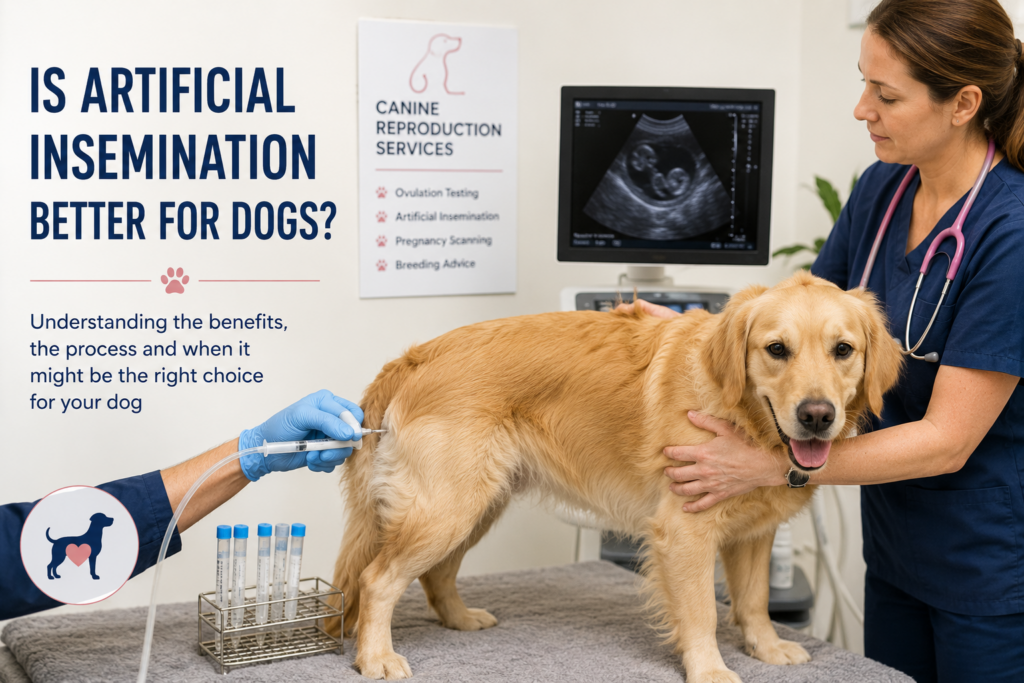
Dog artificial insemination is a veterinary breeding technique in which semen is collected from a male dog and carefully introduced into a female dog’s reproductive tract without the need for natural mating.
The procedure can be performed using fresh, chilled or frozen semen, depending on the breeding plan and the location of the stud dog.
When carried out by experienced veterinary professionals and combined with accurate ovulation testing, artificial insemination can achieve excellent conception rates.
Is Artificial Insemination Better Than Natural Mating?
There isn’t a single answer that applies to every breeding.
For some dogs, natural mating remains the most appropriate option. For others, dog artificial insemination offers significant advantages and may provide a better chance of a successful pregnancy.
Rather than one method being universally better than the other, the decision should be based on the individual dogs and the advice of your veterinary team.
What Are the Advantages of Dog Artificial Insemination?
Artificial insemination offers a number of benefits that have made it an increasingly popular breeding option. These include:
- Access to stud dogs located elsewhere in the UK or overseas
- The ability to use chilled or frozen semen
- Reduced stress associated with travelling dogs long distances
- Avoiding physical difficulties during natural mating
- Helping to preserve valuable bloodlines
- Allowing breeding from dogs that may no longer be able to mate naturally
- Providing greater flexibility when planning a breeding programme
For many owners, these advantages make artificial insemination a practical and effective option.
Can Artificial Insemination Improve Pregnancy Rates?
Artificial insemination itself does not automatically guarantee a higher pregnancy rate. However, when combined with accurate ovulation testing and high-quality semen, it can significantly improve the chances of successful conception in situations where natural mating may be less successful.
By using progesterone testing to accurately identify ovulation, insemination can be carried out during your dog’s most fertile period, helping to maximise the likelihood of pregnancy.
When Is Artificial Insemination Recommended?
Your veterinary team may recommend dog artificial insemination in several situations. These include:
- When the stud dog lives a considerable distance away
- When using chilled or frozen semen
- If either dog has physical difficulties with natural mating
- When previous natural matings have been unsuccessful
- To reduce unnecessary travel for breeding dogs
- When preserving important genetics for future generations
However, it is important to note that every breeding is different, so your vet will recommend the most appropriate approach based on your dog’s individual circumstances.
How Important Is Ovulation Testing?
Whether you’re planning natural mating or dog artificial insemination, accurate ovulation testing is one of the most important factors affecting breeding success.
Because every female dog ovulates at a slightly different point during her season, it is difficult to predict the ideal breeding date based on behaviour or calendar dates alone.
Benefits of Progesterone Testing
Progesterone testing allows you to determine the optimal breeding window, helping to:
- Improve conception rates
- Reduce unnecessary repeat matings
- Ensure insemination takes place at the correct time
- Maximise the success of chilled and frozen semen
- Take the guesswork out of breeding
For many owners, ovulation testing provides reassurance that breeding is being timed as accurately as possible.
What Happens After Artificial Insemination?
Following the procedure, your dog can usually return home shortly afterwards and continue her normal routine, although your veterinary team may provide specific aftercare advice.
If conception is successful, pregnancy can usually be confirmed with a dog pregnancy check using an ultrasound scan from around 25 to 30 days after insemination.
This allows your vet to assess the developing puppies and monitor the progress of the pregnancy.
What Are the Best Practices When Considering Dog Artificial Insemination?
If you are thinking about using artificial insemination, there are several best practices to follow:
- Arrange a pre-breeding health assessment.
- Carry out any recommended health and genetic screening.
- Use progesterone testing to accurately identify ovulation.
- Discuss the most appropriate insemination method with your veterinary team.
- Confirm pregnancy with a dog pregnancy check using an ultrasound scan.
- Continue regular veterinary care throughout the pregnancy.
So, Is Artificial Insemination Better for Dogs?
In many situations, it can offer significant advantages over natural mating, particularly when distance, physical limitations or the use of chilled or frozen semen make natural breeding more difficult.
However, there is no single breeding method that is right for every dog. By working closely with your veterinary team and combining dog artificial insemination with accurate ovulation testing, you can make informed decisions that give your dog the best possible chance of a healthy pregnancy and a successful litter.