

Can dogs be artificially inseminated?
Aug
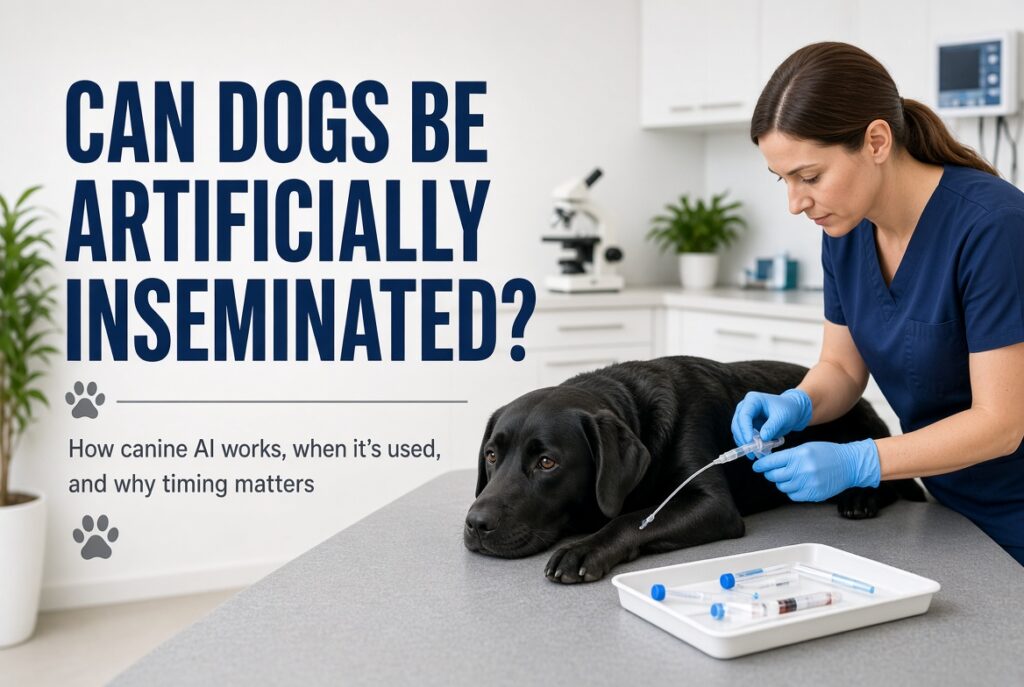
If you’re planning to breed your dog, you may be researching all the different options available, including artificial insemination. But can dogs be artificially inseminated? Why might you choose this option, and what does the process involve?
So can dogs be artificially inseminated?
The short answer is yes. Artificial insemination is a long-established option for canine breeding and it can be a useful and effective technique if natural mating is difficult, impractical, or not possible.
However, artificial insemination is not necessarily the right choice for every dog. Successful artificial insemination depends on a range of factors including your dog’s health, fertility, the quality of the semen, and the timing of ovulation.
Can all dogs be artificially inseminated?
Artificial insemination can be the perfect choice for many different breeds and circumstances, but suitability depends on the individual dogs involved. Your veterinary team will consider factors such as:
- The health and age of both dogs
- The reproductive health of the female
- The quality of the semen
- Whether fresh, chilled, or frozen semen is being used
- The timing of ovulation
- Any previous breeding difficulties
This is why a thorough veterinary assessment before breeding is essential, as it can help determine whether this process will be right for your dog.
Why might you choose artificial insemination?
If you’re thinking of breeding your dog, there are several reasons why you may consider artificial insemination rather than natural mating. Some of these reasons may include:
- Physical distance between male and female dogs
- Physical or behavioural problems that may prevent natural mating
- Using semen from a dog located elsewhere in the UK or overseas
- Using chilled or frozen semen
- Reducing the need for long-distance travel
- Preserving valuable genetics
- Breeding from a male dog that is no longer able to mate naturally
- Previous unsuccessful natural matings
What types of semen can be used?
Several types of semen can be used effectively for artificial insemination, and this flexibility is another reason why this technique is so popular.
Fresh semen
Fresh semen is collected from the male dog and used relatively soon afterwards. This can be useful when both dogs are in the same location and breeding can be carefully timed around ovulation. A semen collection and assessment is usually carried out first.
Chilled semen
Semen can be specially prepared and chilled so that it can be transported to another location. This can make breeding between dogs that live some distance apart considerably easier.
Frozen semen
Frozen semen can be stored for much longer periods, allowing genetics to be preserved for future use. It can also make it possible to use semen from a male dog that is no longer available for natural mating. Because frozen semen has different characteristics from fresh semen, accurate timing and an appropriate insemination technique are particularly important.
How is artificial insemination carried out?
The exact procedure depends on the type of semen being used and the individual circumstances, but the process generally begins with semen collection from the male dog. This will then need to be assessed by a professional to determine its quality, including factors such as sperm concentration and motility. You can learn more about this on our stud dog sperm fertility testing page.
At the same time, your female dog’s reproductive cycle is carefully monitored to identify the breeding window. At this stage, the semen can be introduced into the female reproductive tract using an appropriate insemination technique.
Your veterinary team will determine which method is most suitable for your dog.
Why is ovulation testing important?
When it comes to dog breeding using any process or technique, accurate timing is one of the most important factors to consider. This also applies to artificial insemination.
Because female dogs don’t tend to ovulate at the same time each season, it can be impossible to identify the right breeding date simply by counting the days from the start of her season. As a result, progesterone testing can be vital to ensure breeding success.
This can be even more important if you are using chilled or frozen semen, as the timing of insemination can have a significant impact on the likelihood of conception.
Does artificial insemination increase the chances of pregnancy?
Artificial insemination does not guarantee pregnancy, but when well timed and planned, it can provide the right opportunity for successful conception.
However, there are several factors that can influence the outcome, including:
- The age of the female
- The fertility of both dogs
- Semen quality
- The type of semen being used
- The timing of ovulation
- The insemination technique
- Any underlying reproductive health issues
This is why veterinary assessment and accurate ovulation testing are such important parts of the process.
What should you do before artificially inseminating your dog?
If you’re considering artificial insemination, preparation is important. You should:
- Arrange a pre-breeding veterinary health assessment
- Complete any recommended breed-specific health and genetic testing
- Discuss the fertility of both dogs with your veterinary team
- Use progesterone testing to accurately identify ovulation
- Assess the quality of the semen being used
- Discuss which insemination method is most appropriate
- Plan for a dog pregnancy check following the procedure
In conclusion
Artificial insemination is a well-established option for dog breeding. However, the success of the procedure depends on careful preparation, good reproductive health, high-quality semen, accurate ovulation testing, and appropriate veterinary support.