

Can You Test Dog Progesterone Levels at Home?
Jul
If you’re planning to breed your dog, you’ve probably come across progesterone testing. As one of the most accurate ways to determine when a female dog is ovulating, it plays an important role in both natural mating and artificial insemination.
But can you test dog progesterone levels at home?
What Is Progesterone?
Progesterone is a naturally occurring hormone that plays a vital role in your dog’s reproductive cycle.
During your dog’s season, progesterone levels begin to rise as ovulation approaches. By measuring these hormone levels, you can accurately identify when your dog is at her most fertile.
When Is Progesterone Testing Useful?
This information is particularly valuable if you’re planning:
- Natural mating
- Dog artificial insemination
- Breeding using chilled semen
- Breeding using frozen semen
Because every dog is different, progesterone testing removes much of the guesswork involved in choosing the best breeding date.
Can You Carry Out Progesterone Testing at Home?
There are some home testing products available that claim to help monitor fertility.
However, unlike specialist progesterone testing, these kits are often limited in the information they provide and may not offer the level of accuracy required when timing a breeding.
Many home tests also require interpretation, making it difficult to know exactly when ovulation has occurred.
If breeding is carefully planned, relying solely on a home test may increase the risk of incorrect timing.
Why Is Accuracy So Important?
Timing is one of the biggest factors influencing whether your dog becomes pregnant. Female dogs have a relatively short fertile window, and every dog’s reproductive cycle is slightly different.
While some dogs ovulate earlier than expected, others ovulate several days later. As a result, without accurate progesterone testing, it can be difficult to know exactly when breeding should take place.
Why Does Semen Type Affect Timing?
This is particularly important if you are using chilled or frozen semen, as these have a shorter lifespan than fresh semen once insemination has taken place.
Accurate timing helps ensure insemination takes place during the most suitable stage of your dog’s fertile window.
How Is Progesterone Testing Performed by a Vet?
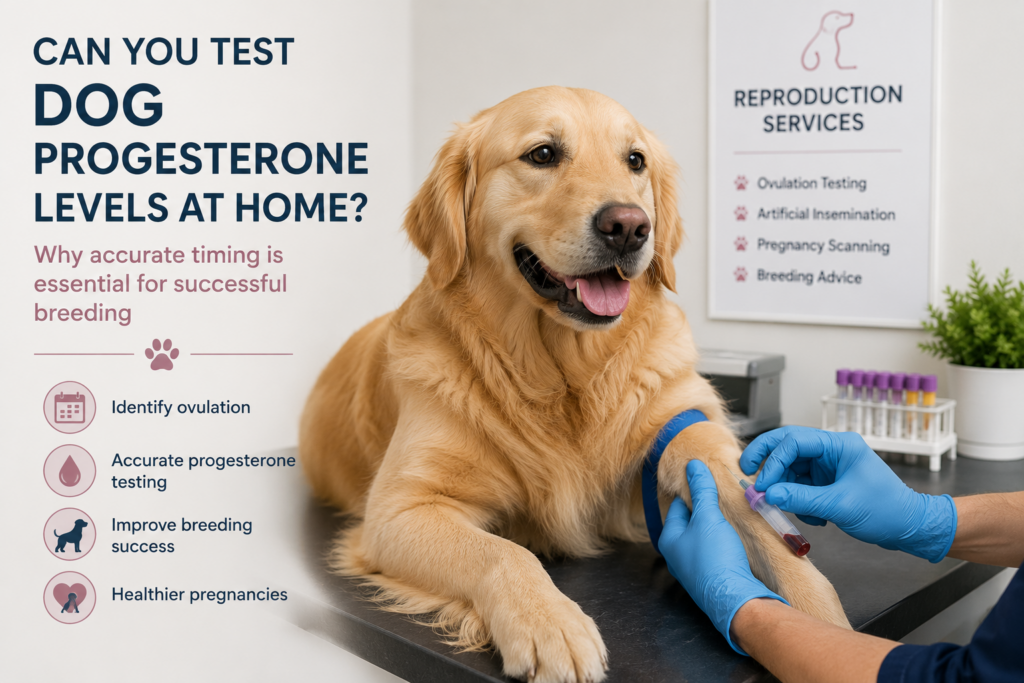
Veterinary progesterone testing is straightforward and minimally invasive.
A small blood sample is taken from your dog and analysed to measure the concentration of progesterone in her bloodstream.
Depending on the results, your vet may recommend repeating the test over several days to monitor the natural rise in progesterone levels.
This allows your veterinary team to identify the optimal breeding window with much greater accuracy than relying on physical signs alone.
What Are the Advantages of Professional Progesterone Testing?
Professional progesterone testing offers a number of important benefits. These include:
- Accurate identification of ovulation
- Improved breeding timing
- Higher chances of successful conception
- Reduced guesswork
- Fewer unnecessary matings
- Better timing for dog artificial insemination
- Support from experienced veterinary professionals
For many owners, these advantages provide reassurance that breeding is taking place at the most appropriate time.
What Happens After Progesterone Testing?
Once your dog’s progesterone levels indicate that ovulation is approaching, your veterinary team can advise you on the best time for natural mating or dog artificial insemination.
Following breeding, you’ll simply wait while the pregnancy develops.
When Can Dog Pregnancy Be Confirmed?
If conception is successful, a dog pregnancy check using an ultrasound scan can usually confirm pregnancy from around 25 to 30 days after mating or insemination.
This provides reassurance that the pregnancy is progressing as expected and allows your vet to monitor the developing puppies.
So, Can You Test Dog Progesterone Levels at Home?
While home testing kits are available, they generally cannot offer the same level of accuracy and reliability as professional veterinary progesterone testing.
Because successful breeding depends so heavily on precise timing, many owners choose veterinary testing to accurately identify ovulation and maximise the chances of conception.
The Most Reliable Approach
Whether you’re planning a natural mating or dog artificial insemination, working closely with your veterinary team can help ensure your dog is bred at the most appropriate time, giving her the best possible chance of a healthy pregnancy.