
How long will a dog be pregnant?
Aug
Dog breeding can be a more complex process than you might initially think. If your female dog has successfully mated recently, you might be wondering whether she is pregnant — and if so, how long she will be pregnant for.
How long is a dog’s pregnancy?
A dog’s pregnancy generally lasts around nine weeks, with an average of approximately 63 days from ovulation.
However, there can be some variation between individual dogs. Because mating and conception do not necessarily happen on the same day, it can be difficult to predict exactly when your dog will give birth.
An important point to remember is that sperm can remain viable within the female reproductive tract for several days, while a dog’s eggs require time to mature following ovulation before they can be fertilised. As a result, the date of ovulation is often much more useful when calculating the expected length of pregnancy.
Why does ovulation matter when calculating pregnancy?
Understanding when your dog ovulated is particularly important if you are planning a litter.
A female dog’s fertile period can vary from one season to another, which makes counting days from the beginning of her season an inaccurate way to identify when she ovulated.
Progesterone testing is the best option. This helps your veterinary team monitor hormonal changes throughout your dog’s season and identify when ovulation is taking place, making it much easier to:
- Identify the optimal breeding window
- Time natural mating accurately
- Plan Dog Artificial Insemination
- Estimate the expected due date
- Understand how far along your dog’s pregnancy is
What happens during the first few weeks?
The first few weeks of pregnancy can pass without many obvious changes.
Following fertilisation, the developing embryos travel through the reproductive tract before eventually reaching the uterus and implanting into the uterine lining.
During this early stage, you may not notice much difference in your dog’s appearance or behaviour. Some dogs may experience subtle changes such as:
- Slight changes in appetite
- Increased tiredness
- Changes in behaviour
- Mild nausea
However, these signs alone are not enough to confirm pregnancy.
What happens during weeks four and five?
As pregnancy progresses, the developing puppies begin to grow more rapidly. This is also around the stage when pregnancy can often be confirmed by your veterinary team.
You may start to notice:
- Enlarged nipples
- A change in appetite
- Gradual weight gain
- Increased sleeping
- Subtle abdominal changes
Every dog is different, and some pregnant dogs show very few outward signs at this stage — which is one of the reasons why veterinary confirmation is so valuable.
What happens during weeks six and seven?
By this point, the puppies are developing rapidly and your dog’s abdomen may become noticeably larger. Her nutritional requirements may increase, while the growing puppies begin to take up more space within her abdomen. You may also notice that your dog:
- Becomes less interested in strenuous exercise
- Sleeps more frequently
- Has an increased appetite
- Seeks additional attention
- Begins displaying nesting behaviours
As the pregnancy progresses, it becomes increasingly important to provide your dog with a comfortable environment and monitor her health closely.
What happens during the final weeks?
During the final couple of weeks, the puppies continue to grow and prepare for birth. Your dog may become noticeably larger and may spend more time resting.
Nesting behaviour can also become more obvious as she begins looking for a suitable place to give birth. You should have your whelping area prepared before this stage so that your dog has plenty of time to become comfortable with it.
As the expected due date approaches, your veterinary team can also advise you about the signs of impending labour and what to expect.
Why is it important to confirm pregnancy?
If your dog has been mated, it can be tempting to simply wait and see whether her body begins to change. However, physical symptoms alone cannot reliably tell you whether she is pregnant.
Dogs can also experience false pregnancy following a season, which can cause symptoms that are very similar to genuine pregnancy.
Confirming pregnancy with a proper dog pregnancy check allows you to know whether puppies are actually developing and gives your veterinary team the opportunity to assess your dog’s health. It also means you can make appropriate preparations for the remainder of the pregnancy.
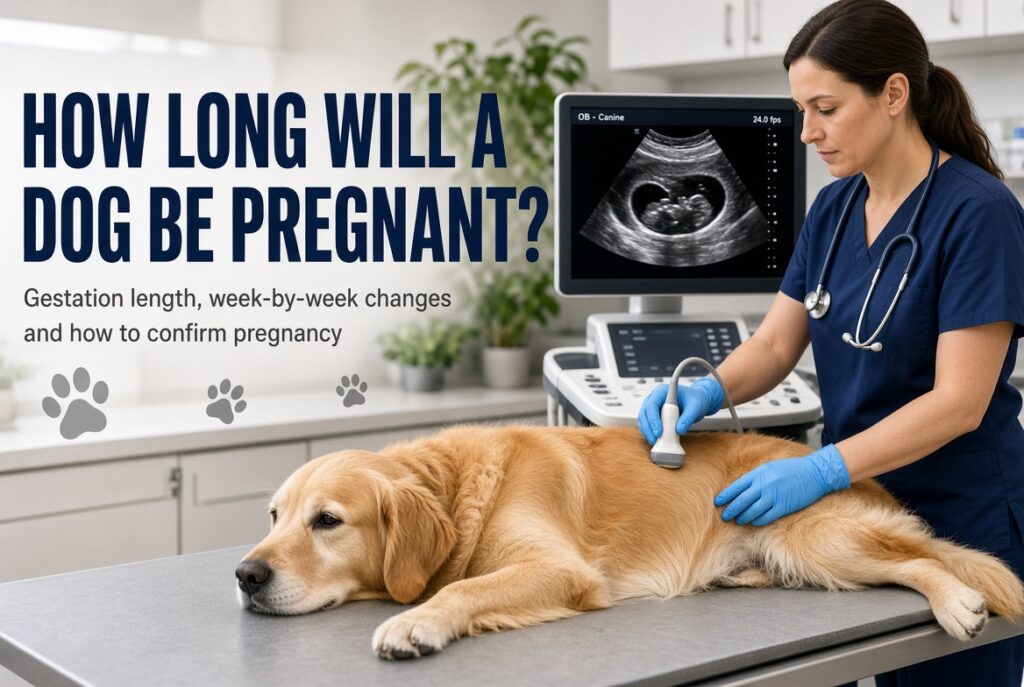
An ultrasound scan is one of the most useful ways to carry out a dog pregnancy check. It can generally detect pregnancy from around 25 to 30 days after mating (although the timing of ovulation can affect when pregnancy becomes visible). An ultrasound allows your vet to:
- Confirm pregnancy
- Assess developing puppies
- Check that the pregnancy appears viable
- Monitor puppy development
- Provide reassurance about the pregnancy
Can you calculate your dog’s due date?
You can estimate a due date, but it is most accurate when based on ovulation rather than simply the date of mating.
If you have used progesterone testing to identify ovulation, your veterinary team may be able to provide a more accurate estimate of when your dog is expected to give birth.
Without this information, there can be more uncertainty because mating may have occurred several days before or after ovulation. This is particularly important when preparing for whelping, as knowing roughly when labour is expected can help you recognise when your dog is approaching the end of her pregnancy.
What happens if your dog goes beyond the expected due date?
Because canine pregnancy is based most accurately on ovulation rather than mating, an apparent overdue pregnancy does not necessarily mean something is wrong.
However, if you are concerned that your dog has gone beyond her expected due date, you should contact your veterinary team. Your vet can assess your dog and determine whether further monitoring or intervention is required.
It’s particularly important to seek advice if your dog appears unwell, is showing signs of distress, or labour does not appear to be progressing normally.
In conclusion
In most cases, canine pregnancy lasts approximately 63 days from ovulation, although individual pregnancies can vary.
Because the date of mating does not necessarily correspond with the date of conception, identifying ovulation can provide a much clearer indication of when pregnancy begins and when your dog is likely to give birth.
Confirming the pregnancy is another important part of the process. An ultrasound scan can provide reassurance that your dog is genuinely pregnant and allow your veterinary team to monitor the developing puppies.